A few must-follow guidelines make a world of difference in a patient’s smile. From bleaching timelines to hydration and reflected light, here’s how to capture a shade that looks completely natural, and helps prevent undesired results.
Bleaching Patients
If a patient has undergone bleaching, schedule the final shade appointment at least two weeks after the last bleaching treatment. Teeth may appear cloudy-white initially and become more translucent after two weeks, which could negatively affect shade matching. When drastic color changes occur following bleaching, color may rebound partially toward the original shade.
Extensive bleaching may require more than two weeks. The shade must be stable at the final appointment to ensure the best color and esthetic result.
Bright Colors Affect Shade
Eliminating reflected colored light sources is essential:
- Patients should remove lipstick before shade assessment.
- Personnel and patients in the shade-taking area should avoid bright-colored clothing, cover with light-blue sheets or smocks.
- Avoid bright-colored walls or furniture that reflect colored light and compromise shade accuracy and photographs.
Hydrate Teeth
Teeth must be hydrated to match the shade, it is best to take the tooth shade before preparation, as shades can be adversely affected by dehydration afterward.
The dentin layer primarily determines natural tooth chroma. Enamel affects this by scattering light, increased scattering creates translucency; reduced scattering produces opacity that masks chromatic dentin.
Shade Tab System
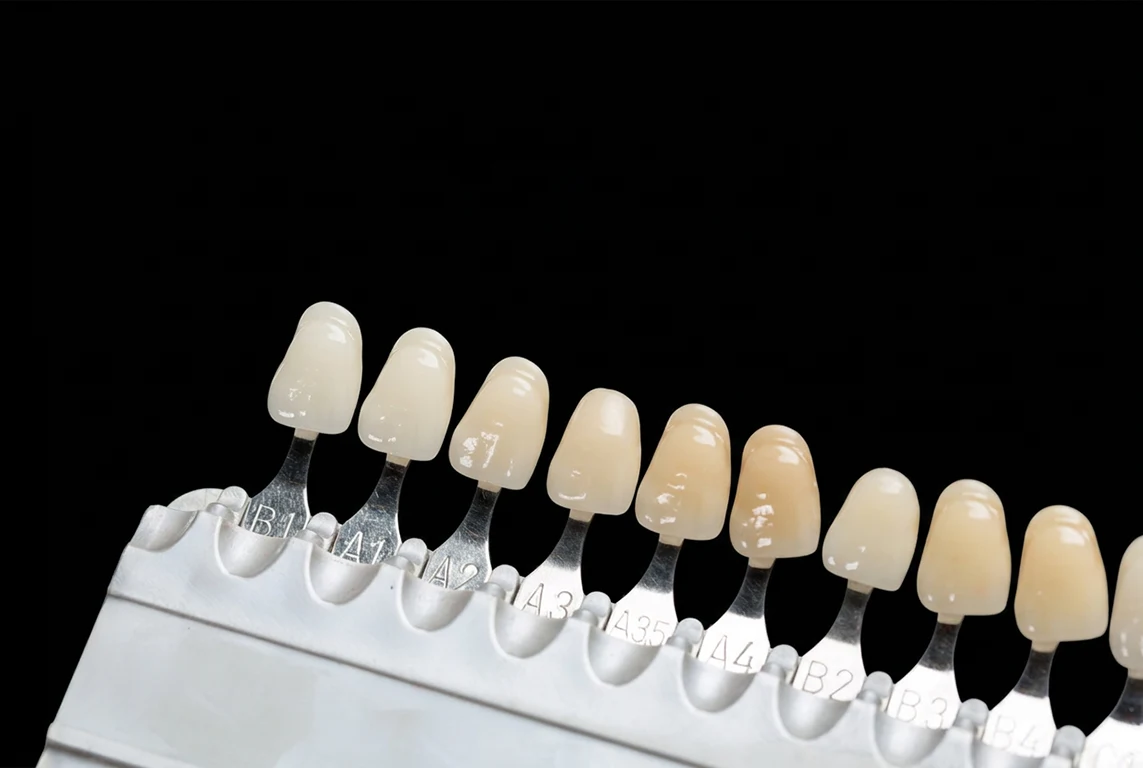
The Vident 3D-Master system provides precise shade evaluation with a systematic arrangement of virtually all existing tooth shades, including bleached shades. Selection follows a three-step process: value first, then chroma, and finally hue.